
Ricoh fi-8290 ADF Scanner with Flatbed
In short: A 90 ppm duplex feeder and an A4 flatbed in one machine. The feeder takes the loose paper; the flatbed takes the things that must never enter a roller path — stapled sets you cannot dismantle, passports, receipts, torn or brittle pages.
If your files are clean loose sheets, the fi-8170 costs less and does the same job. The flatbed is worth paying for the moment someone starts putting fragile originals aside "to deal with later".
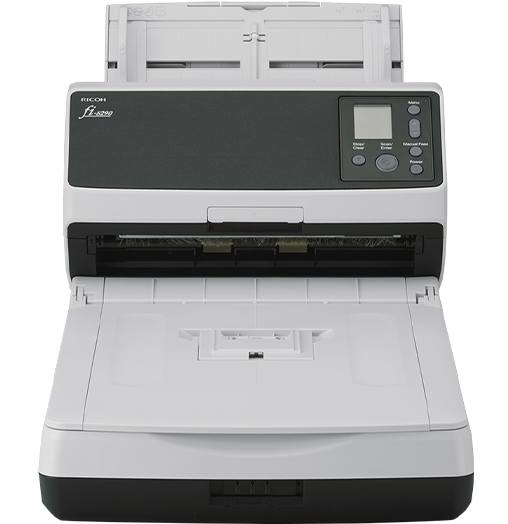
One machine so nothing gets set aside
Every records office has a pile of items the feeder cannot take. In practice that pile does not get scanned — it waits for a trip to the flatbed in another room, and then it waits longer. Putting both paths in one machine is less about speed than about making sure the awkward twenty per cent of a file actually reaches the archive.
Two sensing systems protect what does go through the feeder. Ultrasonic double-feed detection stops the run when two sheets travel together, so pages are never silently skipped. Paper-protection sensing halts the transport when a sheet starts to crumple, before it tears.
Sort
Loose sheets to the feeder; stapled, bound and fragile items to the flatbed.
Feed
90 ppm duplex through the ADF for everything that can safely travel.
Place
Passports, receipts and torn pages scanned flat, in the same batch and profile.
Output
PaperStream Capture to searchable PDF, PDF/A or TIFF, indexed and routed.
fi-8290 at a glance
Figures from Ricoh published data. Speeds are measured on clean A4 at 200/300 dpi; sustained throughput on aged or mixed stock is lower, and we will tell you what we measured on your own documents.
Where the fi-8290 sits
The question is not speed — it is whether your files contain anything that should not go through rollers.
Owning the machine makes sense wherever mixed files arrive daily. One-off legacy boxes are usually cheaper per page through our bureau, where preparation and QC are already staffed.
Government buyers procure through GeBIZ, where Micrographics Data is a registered supplier.
Why pay for a flatbed when the feeder is faster?
Because the feeder cannot take everything. Passports, stapled sets, receipts and torn pages have to be scanned flat, and if the flatbed is in another room those items quietly never get scanned. The flatbed is not about speed — it is about completeness of the file.
What is the difference between the fi-8290, fi-8270 and fi-8250?
The same ADF-plus-flatbed design at different speeds and duty ratings. The fi-8250 suits light workloads, the fi-8270 everyday mixed capture, and the fi-8290 the busiest departments at 90 ppm. Choose on how much passes through the feeder daily.
Can we scan books on the flatbed?
A thin bound item can be scanned flat page by page, but the glass is A4 and pressing a spine down to flatten it damages bindings. Anything bound, valuable or thicker than a slim booklet belongs on an overhead book scanner.
Does it scan both sides in one pass?
Yes, the ADF is duplex — front and back are captured in a single pass, and blank reverse sides can be dropped automatically in the capture profile.
How much does the Ricoh fi-8290 cost?
It is quoted per configuration — software, accessories, installation, training and support all change the figure. Micrographics Data issues a written quotation, and a GeBIZ quotation for government agencies and statutory boards.
Do you install and service Ricoh in Singapore?
Yes. Delivery, installation, operator training, consumables and maintenance contracts are all handled by our own Singapore team.
Show us a typical file
We demonstrate the fi-8290 on your own documents — feeder and flatbed both — and quote installed.