
Ricoh Production Document Scanners
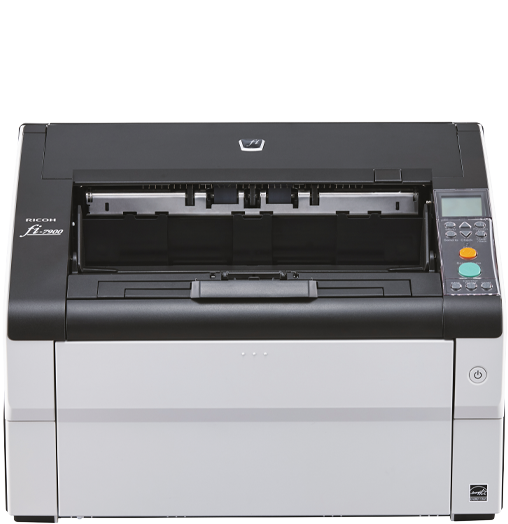
In short: The heavy-duty tier below the fi-8950: fi-8930 and fi-7900 for enterprise batch capture, fi-7800 as the value production option, and fi-7600 where the production work is A3. Large hoppers, ultrasonic double-feed detection and paper-protection sensing across the group.
Above these, the fi-8950 at 150 ppm with a 750-sheet feeder; beyond that, continuous multi-shift running is InoTec SCAMAX territory.
Buy the duty cycle, not the headline speed
Production scanners are specified on what they sustain, not what they peak at. A machine rated for continuous batch work has a heavier transport, a larger hopper, longer consumable intervals and better separation across mixed paper — all of which show up as uptime rather than as a number on the datasheet.
Two sensing systems do the archival work. Ultrasonic double-feed detection stops the run when two sheets travel together, so pages are never silently skipped. Paper-protection sensing halts the transport when a sheet begins to crumple, before it tears. On records with legal or audit value those matter more than throughput.
Prepare
Fasteners removed, tears repaired, batches separated by barcode or patch code.
Load
Hoppers sized so the operator prepares while the machine runs.
Protect
Double-feed and paper-protection sensing stop the run before loss or damage.
Output
PaperStream Capture to searchable PDF, PDF/A or TIFF, indexed and routed.
Ricoh Production Scanners at a glance
Figures from the manufacturer's published specification. Confirm current options and configuration with our quotation.
The Ricoh fi-series by class
Daily volume sets the class; what is in the file decides whether you also need a flatbed or A3.
Preparation, not scanning, is where backfile hours go. We quote the machine and our bureau side by side so the comparison is honest
Government buyers procure through GeBIZ, where Micrographics Data is a registered supplier.
Which production model should we choose?
Work from sustained daily volume and paper condition. fi-7800 for value production, fi-7900 and fi-8930 for enterprise batch work, fi-7600 where the production work is A3, and fi-8950 where volume justifies a 750-sheet feeder. We measure on your own documents before recommending.
What is the difference between the fi-7900 and fi-8930?
Both are heavy-duty production machines from different generations of the range. The practical differences are imaging, software support and consumable intervals rather than purpose. Tell us your volume and we will quote the appropriate current model.
Do production scanners handle damaged paper?
They tolerate mixed sizes, weights and ordinary ageing far better than office scanners, which is much of the point. Stapled, bound or torn material still has to be prepared — no transport repairs paper.
Should we buy or use your bureau?
Buy for ongoing day-forward capture with trained operators. Outsource a finite backfile: preparation and QC are already staffed at our bureau, and you pay per page rather than per shift.
How much do they cost?
Quoted per model and configuration, installed. Micrographics Data issues a written quotation, and a GeBIZ quotation for government agencies and statutory boards.
What is the daily volume, and what is the paper like?
Send a representative batch. We run it, report measured throughput, and quote the right model installed.