
Elsec 765 Environmental Monitor
In short: One handheld instrument that reads the four things that damage collections — visible light, ultraviolet, temperature and relative humidity — so a gallery survey is a single walk round rather than four instruments and four sets of notes.
Monitoring is what turns environmental control from an assumption into a fact. Buffering, blinds and air-conditioning all fail quietly; only measurement tells you when.
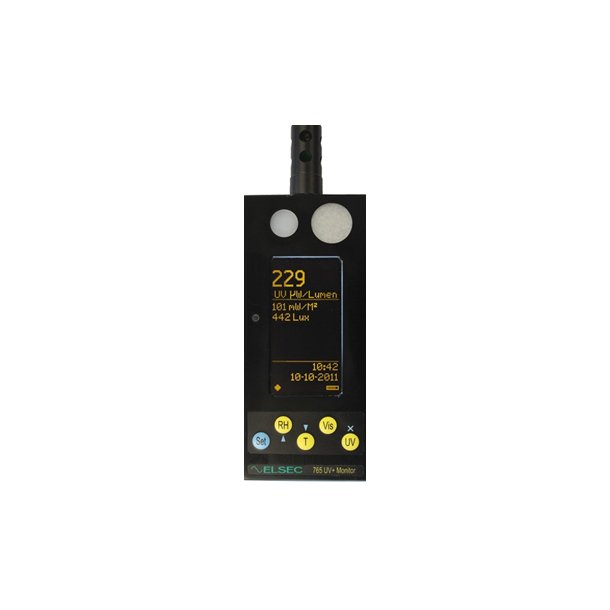
Four measurements, one walk round the gallery
Light and UV damage is cumulative and irreversible: exposure adds up over every hour an object is on display, and nothing brings faded pigment back. Temperature and humidity work differently — they cause movement, cracking and mould, and what matters is fluctuation as much as absolute value. Reading all four at the object, rather than at the wall thermostat, is what makes the data usable.
In practice the instrument earns its place at the awkward moments: checking a case near a newly installed spotlight, proving an RH excursion to a lender, or surveying a store nobody has measured in years. Spot readings are not a substitute for continuous logging where a case is under question — they are how you find out which cases are worth logging.
Plan
Survey points chosen at the object, not at the wall.
Measure
Light, UV, temperature and RH read in one pass.
Record
Readings logged against case, date and lighting state.
Act
Blinds, lamps, buffering or HVAC adjusted on the evidence.
Elsec 765 Monitor at a glance
Figures from the manufacturer's published specification. Confirm current options and configuration with our quotation.
Environmental control and monitoring
Measure first. Equipment bought without a survey usually solves the wrong problem.
Spot readings find problems; continuous logging proves them. For loan conditions and disputes, log the case rather than relying on walk-round measurements
Government buyers procure through GeBIZ, where Micrographics Data is a registered supplier.
Why measure UV separately from visible light?
Because they damage differently and are controlled differently. Visible light exposure is managed by lamp choice, levels and display time; UV should simply be eliminated with filtering. An acceptable lux reading tells you nothing about the UV content of the source.
Is light damage reversible?
No. Fading and photochemical degradation accumulate over every hour of exposure and cannot be undone. That is why exposure budgets — level multiplied by hours — matter more than any single reading.
Do spot readings replace data loggers?
No. They find problems and characterise a space quickly; loggers prove behaviour over time. Use the monitor to decide which cases deserve a logger, and use loggers where you need evidence for a lender or a dispute.
Where should we take readings?
At the object, in the case, in the lighting state the object actually lives in. Readings taken at the wall or with the gallery lights up for maintenance describe a room nobody is exhibiting in.
Does it need calibration?
Instruments of this type are calibrated on a manufacturer schedule. We confirm the current interval and routing when quoting, so the requirement is visible before purchase rather than after.
How much does the Elsec 765 cost?
It is quoted per configuration, delivered. Micrographics Data issues a written quotation, and a GeBIZ quotation for government agencies and statutory boards.
What do you need to survey?
Tell us whether it is galleries, stores or loan cases. We advise on the instrument and what else you will need, and quote delivered.