
Wolfenbütteler Buchspiegel 45° Book Scanner
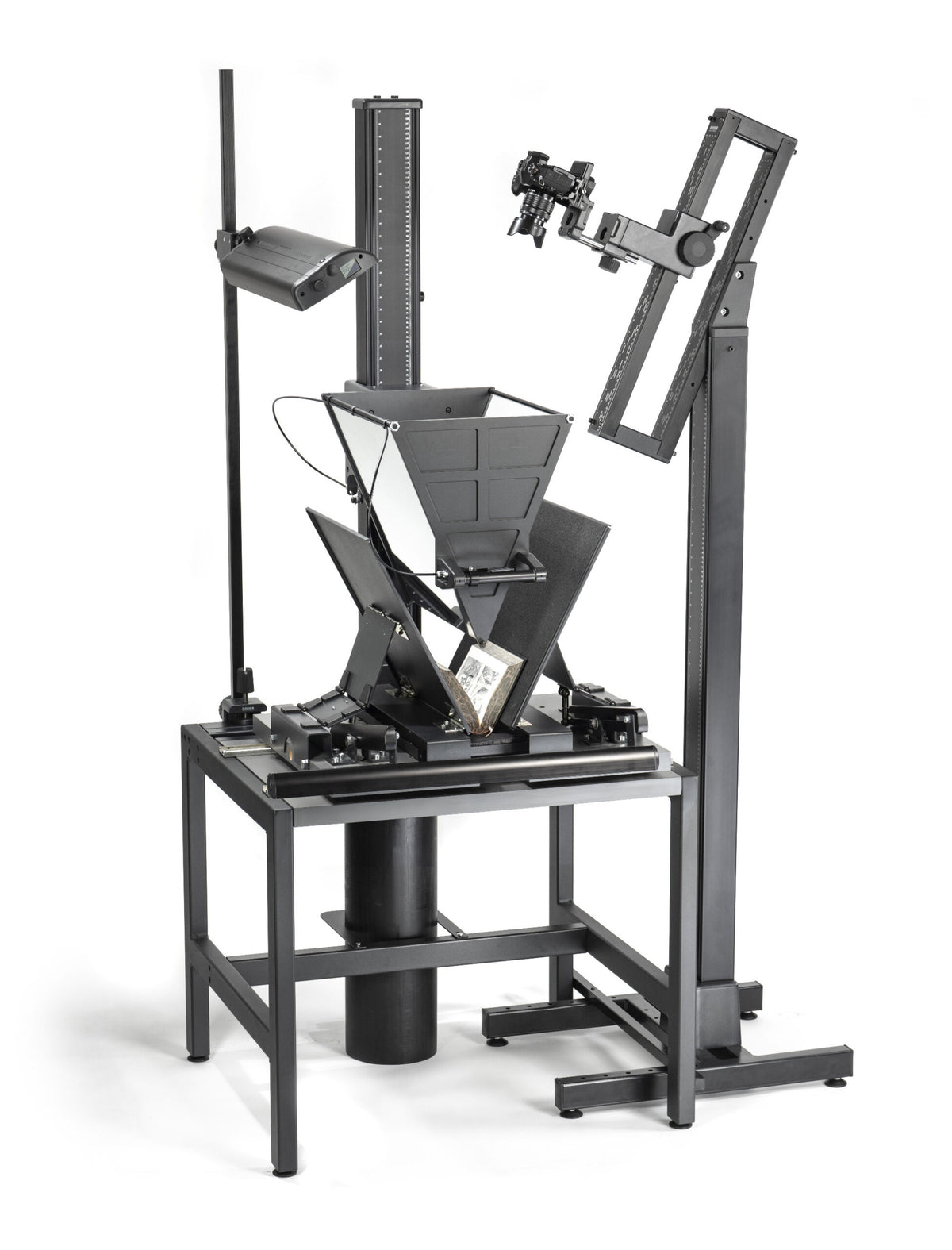
In short: A book scanner for volumes in such a critical state that they can open only to 45°. The book rests in a V-wedge, a glass-and-mirror wedge lowers onto the spread, and the camera captures the mirrored page, which the software flips back to a true-reading image.
Developed jointly by Kaiser Fototechnik, Image Engineering and the Herzog August Bibliothek Wolfenbüttel, and supplied in the Book2net range with book2net software and M70 or M150 cameras. For bindings that open to 90–110°, see the Falcon, Lizard, Cobra or Dragon.
Scanning at 45°, through a mirror
Scanning a part-opened book from above distorts the text near the fold. The Buchspiegel avoids this: the V-shaped wedge has a glass face that flattens the page being scanned and a mirror face that reflects it to the camera, so the image looks as if it were captured square-on.
The spine sits on a padded, fabric-covered support, and the side supports move individually to suit the book's thickness. Only about 4 mm is hidden in the fold, and the software mirrors each image back to a true-reading copy.
Support
Book placed in the 45° wedge on padded supports.
Lower
Counterweighted mirror wedge lowered onto the spread.
Capture
Camera captures the mirrored page.
Correct
Software mirrors the image back to true-reading.
Wolfenbütteler Buchspiegel at a glance
Figures from the manufacturer's published specification. Confirm current options and configuration with our quotation.
The Book2net range
Choose by how far the binding safely opens, the largest format, and how much material there is.
If the binding opens safely to 90° or more, a V-shape scanner such as the Falcon or Lizard is faster.
Government buyers procure through GeBIZ, where Micrographics Data is a registered supplier.
What is the Wolfenbütteler Buchspiegel?
A book scanner for historical volumes whose condition allows an opening angle of only 45°. It was developed by Kaiser Fototechnik, Image Engineering and the Herzog August Bibliothek Wolfenbüttel and is supplied in the Book2net range.
Why does it use a mirror?
At 45°, a camera above the book would see the pages at a steep angle and distort them near the fold. The mirror face of the wedge reflects the page to the camera square-on; the software then mirrors the image back.
Which books suit it?
Manuscripts, early printed books and other volumes with brittle spines or tight bindings that cannot safely open past 45°.
How large and thick can the book be?
Pages up to 45 × 45 cm, which covers A3, and books up to 20 cm thick. About 4 mm is hidden in the fold.
Which camera does it use?
We supply it with book2net M70 or M150 cameras and book2net software. The system also allows a user-selected camera and lighting unit.
How much does it cost?
It is quoted per configuration — camera, lighting, software, workstation, training and support all change the figure. Micrographics Data issues a written quotation, and a GeBIZ quotation for government agencies and statutory boards.
Should we buy or use your bureau?
Buy where material cannot leave the building, the programme runs for years, or staff can operate the scanner part-time. Use the bureau for a one-off collection, a deadline, or material needing conservation attention first.
How far do your most fragile volumes open?
Send the opening angle, page size and thickness; we recommend the Buchspiegel or a V-shape model and quote.