
Book2net Cobra A2/A1 V-Shape Book Scanner
In short: The Cobra is a semi-robotic V-shape book scanner for the most valuable bound material — illuminated manuscripts, incunabula, fragile registers. Two Book2net X71 71-megapixel cameras capture a spread in 0.3 seconds at 400 or 600 dpi while a computer-controlled glass plate and cradle hold the book at 110° under electronically sensed pressure. Available in A1 and A2.
The Gutenberg Museum in Mainz digitised its Gutenberg Bibles on a Cobra A2. Micrographics Data supplies, calibrates and services the Cobra in Singapore.
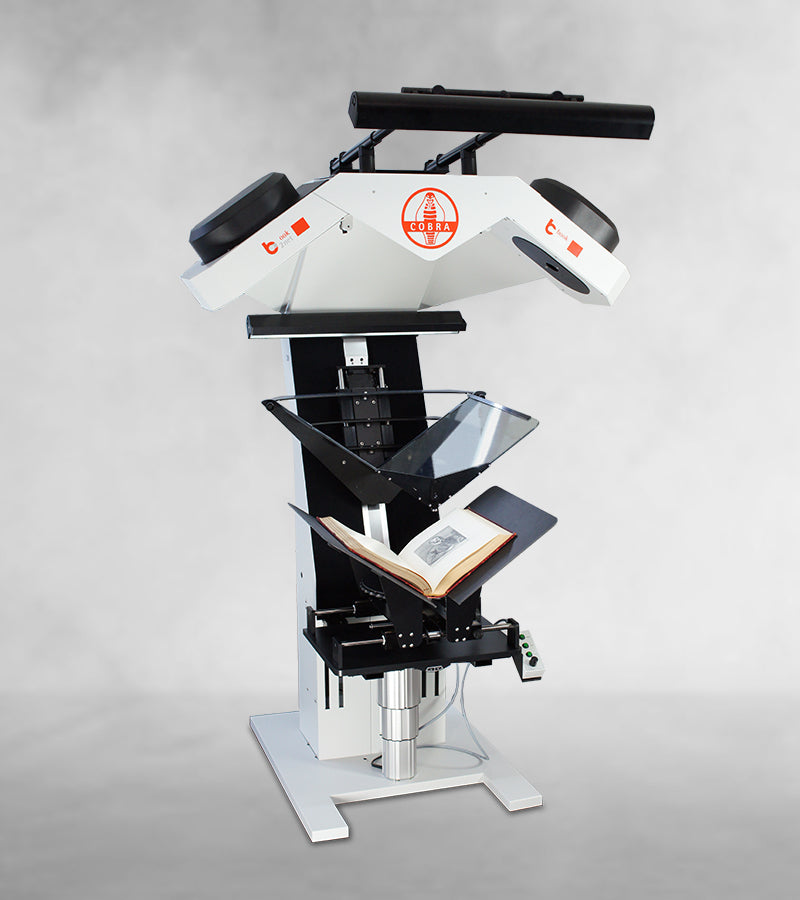
Gentle by design, fast by consequence
The book sits in a V-shaped, preservation-approved cradle whose two halves move independently to follow the spine. A matching V glass plate descends under PLC control; pressure is electronically sensed and limited, and can be switched to fully automatic, semi-automatic or manual.
Two 71 MP area cameras with Schneider-Kreuznach lenses fire together, so a spread is captured in 0.3 s and processed in about 3.5 s. Throughput is limited by the operator turning pages — roughly 700 pages per hour — not by the camera.
Cradle
Independent V halves adapt to spine and thickness; opening angle 80°–120° selectable.
Glass
V glass plate lowers under electronic pressure control; can be swapped or omitted for glassless capture.
Capture
Twin X71 cameras, 400/600 dpi, 0.3 s; colour managed to Metamorfoze / FADGI / ISO 19264-1.
Process
Easy Scan crops, splits and corrects; TIFF, JPEG 2000, PDF/A ready in about 3.5 s per spread.
Cobra A2/A1 brochure and video
Manufacturer video from book2net.
Specifications, options and configurations as published by the manufacturer.
Book2net Cobra A2/A1 at a glance
Figures from the manufacturer's published specification. Confirm current options and configuration with our quotation.
Cobra against its Book2net siblings
All four are V-shape scanners for fragile material; they differ in format and degree of automation.
Rare-book projects are often one-off. Before buying, compare with book scanning as a service on the same equipment.
Government buyers procure through GeBIZ, where Micrographics Data is a registered supplier.
What makes the Cobra suitable for rare books?
The V-shape cradle never opens the book beyond its safe angle, pressure on the pages is electronically sensed and limited, lighting can be reduced to 2,000 lux, and the glass plate can be omitted entirely. That combination is why conservators at institutions such as the Gutenberg Museum specify it.
A1 or A2?
A2 covers folios, registers and most manuscripts. A1 is needed for atlases, bound newspapers and large choir books. The A1 system is physically larger and costs more; choose by the largest volume you will actually scan.
How fast is it in practice?
Capture is 0.3 s and processing about 3.5 s per spread, so the operator turning pages sets the pace — around 700 pages per hour on robust material, slower on fragile bindings where each page is checked.
What resolution does it deliver?
400 or 600 dpi optical at full format from two 71 MP cameras; higher effective resolution at smaller formats. Colour is managed to Metamorfoze, FADGI and ISO/TS 19264-1 with supplied targets.
Can it scan without the glass plate?
Yes. Glassless capture is a standard mode for material that must not be touched; the V cradle alone holds the pages. Glass plates at 80°–120° are interchangeable for material that benefits from gentle flattening.
What software is included?
Book2net Easy Scan for capture, cropping, page splitting, curvature correction and batch output to TIFF, JPEG 2000, PDF and PDF/A. Integration with NAINUWA or other digital library platforms is available.
Do you install and support it in Singapore?
Yes. Installation, colour calibration, operator training, warranty and preventive maintenance are handled by Micrographics Data technicians in Singapore; the same model runs in our own bureau.
Buy the Cobra or use your scanning service?
Buy when rare-material digitisation is a continuing programme and volumes cannot leave the building. For a one-off collection, our bureau scans on the same Cobra with trained conservators handling the material. We quote both.
Bring a volume to our bureau
We scan a sample on the Cobra, show the files, and quote purchase and service side by side.