
Japanese Kozo Conservation Tissue
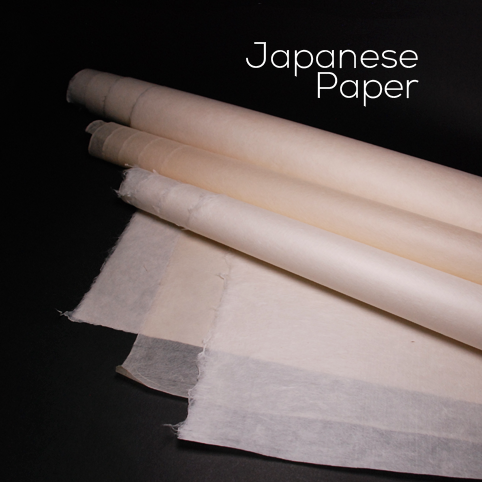
In short: Kozo tissue is made from long mulberry fibres, so it is strong for its weight and stays flexible. Conservators use it to mend tears, hinge prints, line weak sheets and fill losses. A kozo repair can be close to invisible and is deliberately weaker than the original, so if stress recurs the repair gives way, not the object. Stocked in white, cream and light brown to match the paper.
Sample swatches are sent before bulk orders so tone and weight can be checked against your material.
Strong, thin and reversible
Long fibres bridge a tear with very little tissue, and feathered edges blend into the surrounding paper. With a reversible adhesive such as wheat-starch paste, the repair can be removed later without harming the object.
Choose the tone closest to the paper and the lightest weight that will hold. Our conservation team can advise on selection for a specific object.
Match
Choose the tone and weight against the paper.
Tear or cut
Tissue torn or water-cut for a feathered edge.
Adhere
Applied with a reversible adhesive.
Dry
Dried under light weight between blotters.
Japanese Conservation Tissue at a glance
Figures from the manufacturer's published specification. Confirm current options and configuration with our quotation.
Archival supplies compared
Tissue repairs the object; boards and Tyvek house and protect it.
Need repairs done for you? Our conservation team handles boxing and encapsulation projects.
Government buyers procure through GeBIZ, where Micrographics Data is a registered supplier.
Why kozo for repairs?
Long fibres make it strong and flexible at low weight, so repairs are thin and nearly invisible.
Why should a repair be weaker than the original?
So that under renewed stress the repair fails first, protecting the object.
Which tones are stocked?
White, cream and light brown.
Can we see samples first?
Yes. Swatches are sent before bulk orders.
Is it stocked locally?
Yes, in Singapore.
Which tones, and how much?
We send swatches, then quote.