
Book2net Hornet A0 Large-Format Book Scanner
In short: An A0 planetary scanner with semi-robotics, built for the material other scanners cannot physically take: bound newspaper volumes, atlases, plan sets and oversize registers. Each lifting column carries up to 180 kg, and spine width accommodates volumes up to 25 cm thick.
Built by Microbox GmbH in Bad Nauheim, Germany. This is the only A0 machine in the Book2net range we carry — below A0, the Dragon covers A1 down to A6 with a variable cradle angle for tighter bindings.
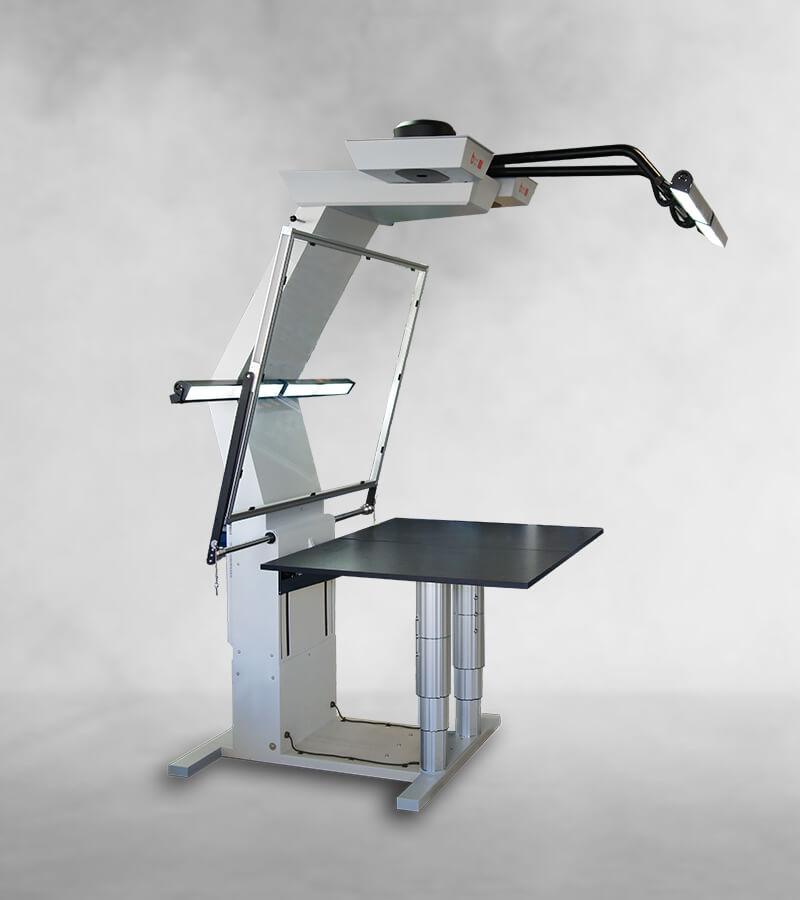
Built for weight as much as for size
A bound volume of nineteenth-century newspapers can weigh 40 kg and stand 25 cm at the spine. The constraint is not optical, it is mechanical: double-profile lifting columns rated to 180 kg each raise and hold that mass precisely, with industrial precision guidance, linear drive and PLC control keeping every moving element smooth. Nothing is lifted by hand mid-scan.
A dual-laser system sets the focus plane within seconds, which matters on A0 where a few millimetres of book-block height change throws focus across the whole sheet. Capture runs at 300 or 400 dpi with a 0.3 second A0 colour exposure and about 3.5 seconds from scan to stored file — true-to-scale, so a plan measures correctly off the image.
Position
Volume or sheet placed on the A0 table; columns take the weight.
Focus
Dual-laser system sets the focus plane in seconds.
Capture
300 or 400 dpi, 0.3 second A0 colour exposure, true to scale.
Deliver
About 3.5 seconds scan to stored file over USB 3.0.
Hornet A0 brochure and video
Manufacturer video from book2net covering the Flash A1, Mosquito A1 and Hornet A0.
Specifications, options and configurations as published by the manufacturer.
Hornet A0 at a glance
Figures from the manufacturer's published specification. Confirm current options and configuration with our quotation.
The Book2net range
Above A1 the question stops being image quality and starts being whether the machine can hold the object safely.
For A2 and smaller, an A0 machine is an expensive way to scan a small book
Government buyers procure through GeBIZ, where Micrographics Data is a registered supplier.
What is the Book2net Hornet A0?
A large-format A0 planetary scanner with semi-robotics, designed for mass digitisation of large, unwieldy or particularly heavy originals such as bound magazine and newspaper volumes, while keeping handling safe.
How much does the Book2net Hornet cost?
It is quoted per configuration — resolution option, height-adjustment range, software, installation and support all change the figure. Micrographics Data issues a written quotation, and a GeBIZ quotation for government agencies and statutory boards.
Why does load capacity matter more than resolution here?
Because at A0 the limiting factor is mechanical. A bound newspaper volume can weigh tens of kilograms; if the scanner cannot raise and hold that weight precisely, staff end up supporting it by hand — which is how spines and shoulders get damaged. The columns are rated to 180 kg each for that reason.
How thick a volume will it take?
Spine width up to 25 cm, with height adjustment to 25 cm as standard and 40 cm optionally. Send the dimensions of your largest and thickest volume and we will confirm fit before quoting.
What does the dual-laser focus system do?
It sets the focus plane in seconds as the book-block height changes. On an A0 surface, a small error in focus distance is visible across the whole sheet, so being able to re-establish it quickly between volumes is what keeps a production run moving.
Is capture true to scale?
Yes — that is a specific requirement for plans and drawings, where the image has to be measurable rather than merely legible. Industrial guidance and linear drive are what hold the geometry.
What resolution should we use for maps and plans?
400 dpi where fine line work, hatching or small annotation matters, 300 dpi where the sheet is large and throughput or storage dominates. It is selectable per job, not fixed at purchase.
What does it need from the room?
A0 machines need access, floor loading and working space around the table for two people to manoeuvre a large volume. We survey the room before quoting — it is the most common reason a large-format installation has to be revised after order.
What is your largest and heaviest volume?
Send dimensions, weight and spine thickness; we confirm fit, survey the room, and quote installed.