
Book2net ARGUS AI Archive Scanner
In short: An A2 archive scanner with an integrated AI module. Alongside the image, it reads print and handwriting, recognises dates, names and places, and proposes content descriptions for the finding aid, all processed locally with no cloud connection.
Staff review and approve every AI result. Built by Microbox GmbH in Germany. For image capture without the AI module, see the Ultra A2 or Kiosk Profi A2.
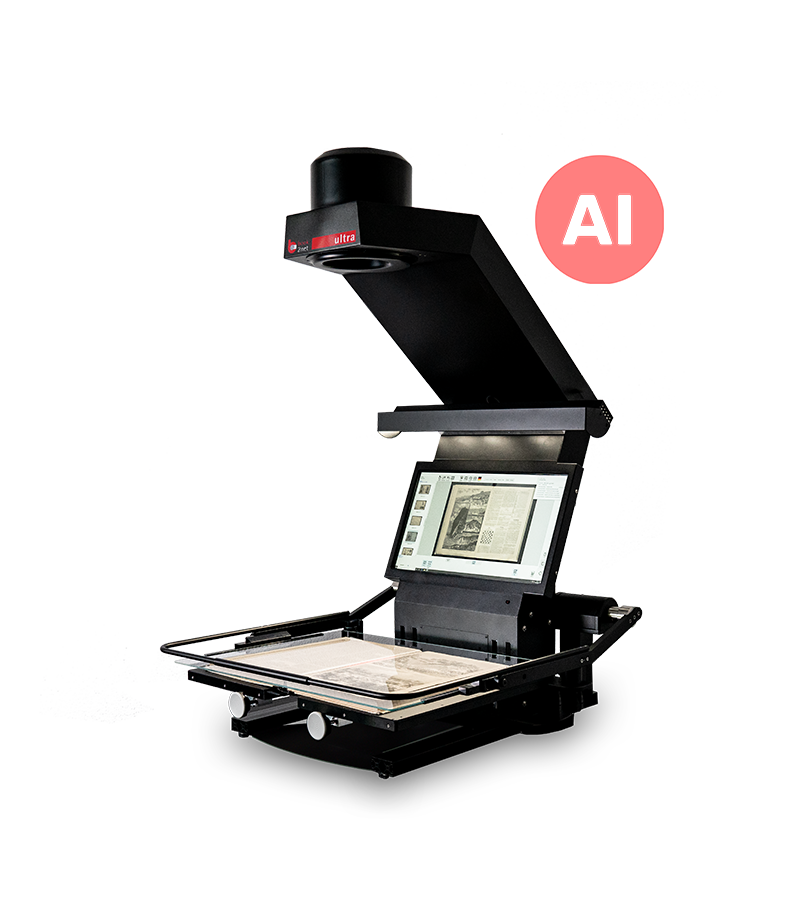
Capture and catalogue in one pass
The scanner is a production A2 system: a self-adjusting motorised cradle with 12/14 cm height compensation and a 10 cm spine release, an automatic glass plate of anti-reflective museum glass, and a Schneider-Kreuznach lens. A colour double page at 400 ppi takes 0.3 seconds; scan, transfer and save take 2.2 seconds.
The AI module then analyses structure, context and layout, transcribes print and handwriting, and proposes descriptive metadata. Results export as XML, JSON or CSV to match the existing finding-aid system, so data entry becomes review and approval.
Place
Cradle self-adjusts; glass plate closes at set pressure.
Capture
0.3 s colour double page at 400 or 600 ppi.
Analyse
AI reads print and handwriting and extracts date, name and place.
Approve
Staff review proposals and export XML, JSON or CSV.
ARGUS A2 at a glance
Figures from the manufacturer's published specification. Confirm current options and configuration with our quotation.
The Book2net range
Choose by how far the binding safely opens, the largest format, and how much material there is.
Send sample pages before you commit: AI transcription quality depends on the hand, language and condition of the material.
Government buyers procure through GeBIZ, where Micrographics Data is a registered supplier.
What is the Book2net ARGUS?
An A2 production archive scanner with an integrated AI module. It captures the image and, in the same workflow, reads the text, identifies key details such as date, name and place, and proposes a content description for the finding aid.
Does the AI need an internet connection?
No. All AI processing runs locally on the system, with no cloud connection, so material and metadata stay inside the institution.
Does it replace cataloguing staff?
No. It proposes transcriptions and descriptions; staff review and approve every result. The work shifts from typing data to checking it.
Can it read handwriting?
The manufacturer lists recognition of both print and handwriting. Accuracy varies with the hand, script and condition, so we test on your own sample pages before quoting.
Which export formats are supported?
Metadata exports as XML, JSON or CSV to match the existing finding-aid system; images save as TIFF, JPEG or PDF.
How much does ARGUS cost?
It is quoted per configuration — resolution, AI module setup, software, workstation, training and support all change the figure. Micrographics Data issues a written quotation, and a GeBIZ quotation for government agencies and statutory boards.
Should we buy or use your bureau?
Buy where material cannot leave the building, the programme runs for years, or staff can operate the scanner part-time. Use the bureau for a one-off collection, a deadline, or material needing conservation attention first.
How are your holdings catalogued today?
Send sample pages and your finding-aid format; we show the AI output on your material and quote the configuration.