
MGD Microfilm Chemistries — MD18c and MF18c
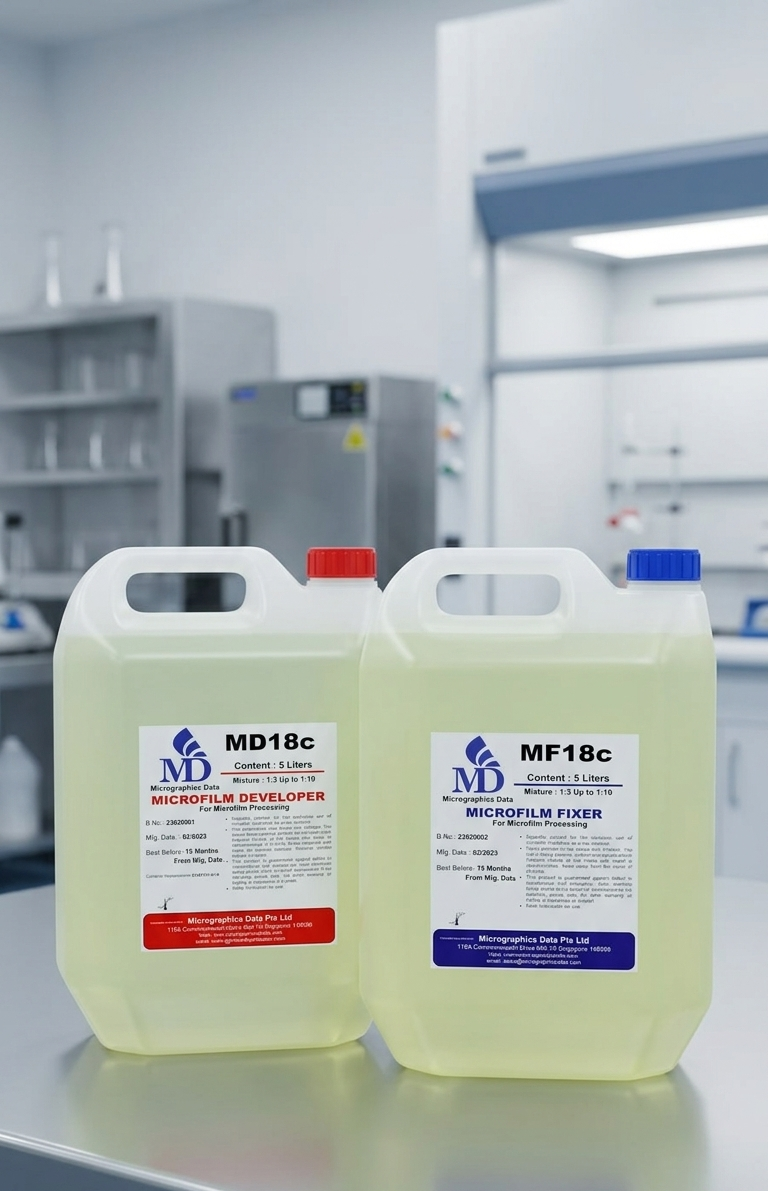
In short: A matched developer and fixer for silver-halide microfilm. MD18c is a concentrated fine-grain developer; MF18c is a hardening fixer formulated for complete fixing and long-term image stability to ISO and ANSI archival processing standards.
Chemistry is where an LE-500 rating is won or lost: the film carries the potential, but residual fixer left by incomplete processing is what eventually fades the silver image. Used in our own bureau alongside MD PRO5 and MD PRO3 processors.
Develop for grain, fix for permanence
MD18c develops fine-grain silver-halide microfilm with the contrast and sharpness that high-resolution stock is capable of. It is supplied as a concentrate and works in continuous processors and manual development alike, with batch-to-batch consistency that matters when a filming programme runs for years rather than weeks.
MF18c then fixes and hardens the emulsion. Complete fixing followed by adequate washing is what leaves residual thiosulfate low enough to pass the ISO 18917 methylene blue test — the measurement archives actually audit. Minimal residual silver after processing also protects against the staining and image degradation that shows up decades later.
Dilute
Concentrate made up to working strength for your processor.
Develop
MD18c at 28–35°C, 18–20 second dwell, with replenishment control.
Fix and wash
MF18c hardening fixer, then wash to remove residual thiosulfate.
Verify
ISO 18917 methylene blue test within 14 days of processing.
MD18c / MF18c at a glance
Figures from the product specification. Ask for the datasheet, safety data sheets and replenishment rates with your quotation.
Film and chemistry range
Match the film to the camera format and the chemistry to the processor. Both must be right for an LE-500 result.
Chemistry alone will not rescue underexposed or poorly washed film — control strips and densitometry are part of the process
Government buyers procure through GeBIZ, where Micrographics Data is a registered supplier.
What is MD18c?
A concentrated fine-grain developer for silver-halide microfilm, formulated for high-resolution stock and stable across batches. It works in continuous processors and in manual development.
What is MF18c?
A hardening fixer that fixes the emulsion completely and leaves minimal residual silver, formulated to meet ISO and ANSI archival processing standards and to prevent the staining and degradation that appears over long storage.
How much does microfilm chemistry cost?
It is quoted by volume and dilution, with standing-order rates for bureaux and archives running continuous lines. Send your processor model and monthly throughput for a quotation.
Why does chemistry decide archival permanence?
Because the failure mode is chemical, not optical. Film rated LE-500 only achieves it if fixing and washing leave residual thiosulfate below the limit — otherwise leftover fixer oxidises the silver image over decades. The ISO 18917 methylene blue test measures exactly this, and it must be run within 14 days of processing.
What processing parameters do you recommend?
Developer 28–35°C with an 18–20 second dwell, fixer 28–35°C and dryer 50–60°C, with replenishment set to throughput. These suit our own 16MGD-HR and 35MGD-HR stock; we confirm against your processor and film.
Is it compatible with other manufacturers’ film?
It is formulated for silver-halide negative-working microfilm generally, not only our own stock. Tell us which film you run and we will confirm parameters before you switch.
What about disposal?
Spent fixer carries dissolved silver and is regulated waste in Singapore. We supply handling and disposal guidance and safety data sheets with the chemistry, and can advise on silver recovery where volumes justify it.
Do you supply the processors too?
Yes — the MD PRO3 and MD PRO5 deep-tank processors are our own build, and the chemistry is specified for them. We also supply chemistry to archives running other processors.
Which processor, and what throughput?
Send your processor model and monthly film volume; we quote chemistry, replenishment rates and disposal guidance together.