
Book2net AutoScan V Robotic Book Scanner
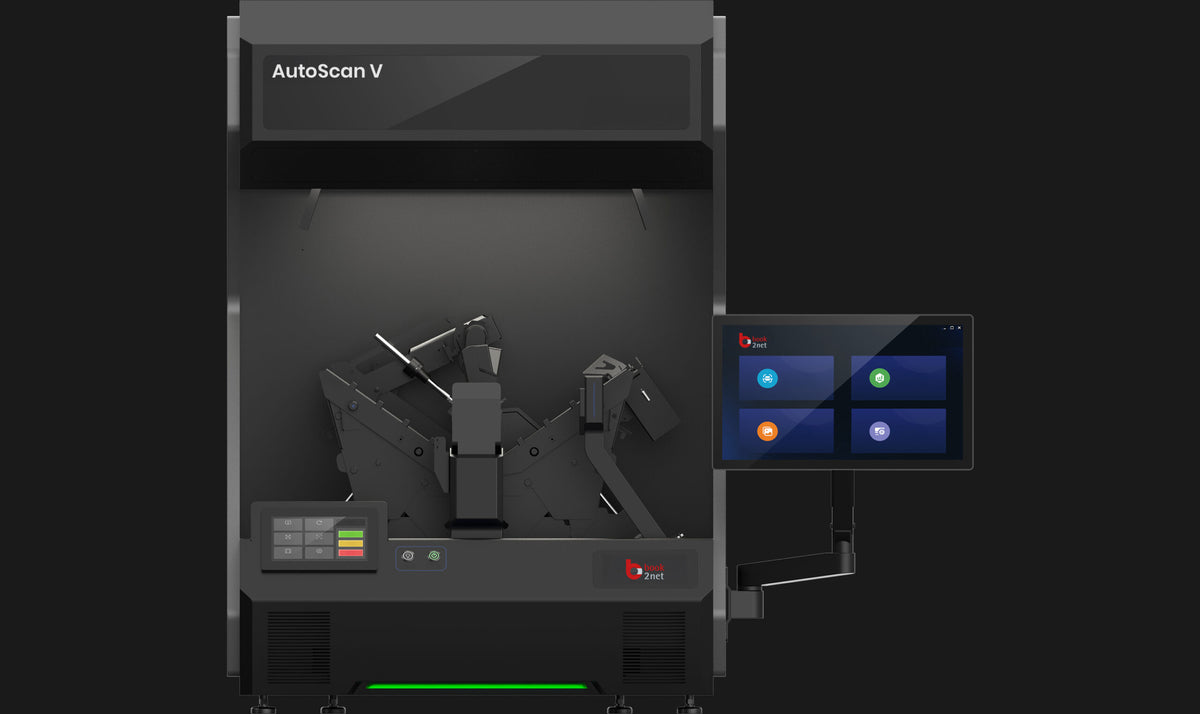
In short: A tabletop robotic book scanner that turns its own pages. Vacuum lift combined with a robotic arm moves one page at a time in a V-shape cradle held at 110 degrees, running 600 to 3,300 pages per hour without an operator standing over it.
Built by Microbox GmbH in Bad Nauheim, Germany. Automation only pays where volumes are uniform and the bindings are sound — for fragile or tightly bound material, the Dragon or Cobra under operator control remains the right choice.
The hard part is turning one page, reliably
A vacuum lifts the top sheet and a robotic arm carries it over, inside a V-cradle fixed at a 110-degree opening angle so the spine is never forced flat. Laser Eye technology then verifies that exactly one page turned — double-page skips are the failure mode that quietly ruins an unattended run, because nobody notices until the volume is back on the shelf.
Capture runs at 600 to 1800 ppi on a matrix sensor. Eagle Eye Dynamic auto-centres volumes of differing sizes so a mixed batch does not need re-rigging, and Eye Flip Mirror correction compensates for page curvature and undulation. Software removes black edges and clamp projection, deletes blank pages, smooths curvature and corrects alignment deviation, with page-edge sensors flagging errors as they happen.
Load
Volume sits in the V-cradle; Eagle Eye Dynamic auto-centres it.
Turn
Vacuum lift and robotic arm move one page; laser verifies the single turn.
Capture
Matrix sensor images the spread at 600–1800 ppi with curvature correction.
Process
Edge and clamp removal, blank-page deletion, alignment correction, OCR.
AutoScan V brochure and video
Manufacturer video from book2net.
Specifications, options and configurations as published by the manufacturer.
AutoScan V at a glance
Figures from the manufacturer's published specification. Confirm current options and configuration with our quotation.
The Book2net range
Automation suits uniform, sound volumes. Fragile or irregular material still wants an operator and a variable cradle.
Automatic page turning is wrong for brittle paper, plates, foldouts or anything already repaired
Government buyers procure through GeBIZ, where Micrographics Data is a registered supplier.
What is the Book2net AutoScan V?
A tabletop robotic book scanner for libraries and archives that turns its own pages using vacuum lift and a robotic arm, capturing up to 3,300 pages per hour at 600 to 1800 ppi in a V-shape cradle held at 110 degrees.
How much does the AutoScan V cost?
Pricing is project-specific — configuration, software, training and support all bear on it, and most installations are part of a wider digitisation programme. Micrographics Data issues a written quotation and a GeBIZ quotation for government agencies and statutory boards, and will arrange a demonstration on your own material first.
Is automatic page turning safe for old books?
It depends entirely on the paper and binding. Sound, flexible modern paper in a serviceable binding turns reliably. Brittle paper, plates, foldouts, previously repaired leaves and anything with loose fragments should not go near an automatic turner — use an operator-led V-shape scanner instead. We test your material before recommending it.
What stops it skipping two pages at once?
Laser Eye technology verifies that a single page has turned before capture proceeds, and page-edge sensors flag errors during the run. That matters more than throughput: an undetected double-turn leaves a gap nobody finds until the volume is reshelved.
Does the 110-degree cradle protect the spine?
It avoids forcing the volume flat, which is the main mechanical risk in bound-material scanning. It is a fixed angle though — if your material needs less than 110 degrees, the Dragon’s adjustable 80 to 120 degree cradle is the correct machine.
What does the software correct automatically?
Black edge and clamp projection removal, blank-page deletion, automatic page-curvature smoothing, alignment deviation correction, text highlighting and watermarking, with error detection from page-edge sensors. That is what makes unattended running practical rather than just fast.
How much floor space does it need?
It is a tabletop unit at 840 × 820 × 1210 mm, so a sturdy bench rather than a dedicated room — unusual for a robotic scanner and often the deciding factor in a crowded reading room or workroom.
Should we buy one or use your bureau?
Buy where you have continuous intake of uniform material and staff to load and check it. Use the bureau for a finite collection, mixed or fragile material, or a deadline. An automatic scanner running the wrong material is slower than an operator, not faster.
How uniform is the material, and how many volumes?
Send a sample batch description; we run volumes on the machine and quote against operator-led alternatives honestly.